Showing posts with label race. Show all posts

Tuesday, July 28, 2020

Early Abolitionists and Slave Revolts - Welcome to the 18th Century

As noted in earlier posts, enslaved Africans were brought to the English colonies in the Americas as early as 1619 (Virginia) and this practice continued and spread throughout the colonies during the 17th Century including places we often think of as free-states, like Massachusetts (earliest slaves in Mass. around 1638).


Senator Tom Cotton recently called slavery a necessary evil in describing conditions in the American colonies. This is an argument that has been made long before the senator's recent comment, as slavery in the colonies is still often attributed to a shortage of necessary labor. In other words, it was difficult for the rich proprietors of the colonies to turn a profit from the colonies for the English Crown without forcing people into free labor.

To describe it as a "necessary evil" is however a radical simplification and discounts movements which started in the 17th Century which questioned the morality of slavery and can be seen as the roots abolitionism.

We'll start this exploration by revisiting William and Hannah Penn's colony, Pennsylvania. William Penn was a Quaker and had founded Pennsylvania as a haven, but while being a Quaker haven the colony allowed slavery. In 1688 a group of Quakers puts together a religious argument against slavery (I call out a religious argument because we are also entering the Enlightenment, a time when humanist arguments are used to describe the state of man and society) noting that the Africans:

"are brought hither against their will and consent, and that many of them are stolen. Now, they are black, we can not conceive there is more liberty to have them as slaves as it is to have other white ones. There is a saying, that we shall do to all men like as we will be done ourselves, making no difference of what generation, descent or color they are." - 1688 Germantown Friends Protest Against Slavery

The Quakers are able to draw on the Gospel teaching of "Do unto others as you would have them do unto you" here. And having endured persecution and feeling that their religious liberties and rights as people had been trampled upon, these Quakers did not see how they could justify doing worse. The argument is made in plain language, that those who have suffered persecution in Europe, certainly can't rightly be a part of oppression in the colonies and still consider themselves Christians.

"But to bring men hither, or to rob and sell them against their will, we stand against. In Europe, there are many oppressed for conscience sake; and here there are those oppressed are of a black color...Ah! Do consider well this thing, you who do it, if you would be done at this manner? And if it is done according to Christianity?"

This is 70 years after the first enslaved Africans were brought to the American colonies. It would another almost 100 years after this that Pennsylvania would become a free-state and almost 200 years before slavery was abolished in the United States.

That's not to say that there weren't efforts, some of which moved from paper and out onto the streets. Less than 40 years later, in New York (formerly New Amsterdam), there was a slave revolt. Like Massachusetts and Pennsylvania, New York is often a place we do not associate with slavery, but by 1711 an official slave market was built by the city and the local government collected sale tax revenues from the slave trade. On April 6, 1712 a group of 23 slaves, "Armed with swords, knives, hatchets and guns, the group sought to inspire the city’s slaves to rise up against their masters by staging a dramatic revolt." A militia is sent out to quell the revolt and capture the slaves, and after being captured "the majority were sentenced to brutal, public executions, including being burned alive and being hung by chains in the center of town."

Less than 30 years later, in South Carolina, slaves marched "down the road, carrying banners that proclaim "Liberty!". They shout out the same word. Led by an Angolan named Jemmy, the men and women continue to walk south, recruiting more slaves along the way. By the time they stop to rest for the night, their numbers will have approached one hundred."

The Stono Revolt, as it's known, comes at a time of escalating tension between England and Spain, with a quick note that Spain still held significant lands in the Americas, including nearby Florida with a colony at St. Augustine. White colonists at the time were required to carry firearms even on Sundays while at church, On their march, "The slaves went to a shop that sold firearms and ammunition, armed themselves, then killed the two shopkeepers...the few whites whom they now encountered were chased and killed, though one individual, Lieutenant Governor Bull, eluded the rebels and rode to spread the alarm." It's not long before armed white colonists are able to respond in kind, "By dusk, about thirty slaves were dead and at least thirty had escaped. Most were captured over the next month, then executed.

In 1733, six years before the Stono Revolt, James Oglethorpe founds Georgia as a free-state, a place for English debtors to work, and Oglethorpe believes slavery will lead to idleness. Oglethorpe also had a moral stance against slavery after hearing about "Job" (the Senegambian - Muslim merchant turned slave in Maryland who I referred to in an earlier post on religion in the colonies). "In December 1732, Job’s distant benefactor (Oglethorpe) sold his stock in the Royal African Co. and severed all ties with British slaving corporation. The precocious prince arrived in London during the spring 1733 while Oglethorpe was establishing the Georgia colony". Oglethorpe feeling terrible about what had happened to Job, purchases Job's freedom and goes about establishing a colony free of slavery. It's hard for us, living after the Civil War, to imagination a time when New York and Massachusetts allowed slavery but Georgia did not.

The empathy expressed by the Quakers in Pennsylvania and the ideas behind Georgia's founding make it clear that slavery wasn't a given. Moral arguments were made by the Quakers in the light of their own persecution, and Oglethorpe presented his case in opposition as a case against white idleness; he expected his white colonists to work. To assume then that slavery was a "necessary evil" is to ignore that not long after it's institution, white settlers in the colonies were questioning it. And it ignores that the enslaved Africans were marching, fighting and dying to assert their own liberties since at least the early 18th Century.

Over time, pleas which start on paper in 1688 evolve into small revolts like 1712 in New York and escalate into bigger revolts like Stono in 1739. These are moments of opportunity to stop and do something different, to recognize a series of escalations and to make reforms as suggested by the Quakers or Oglethorpe. Instead of pursuing the cause of the liberty, the colonies instead become more oppressive and crackdown on African slaves. Codified oppression takes hold in a number of the colonies. One example is the Negro Act of 1740 in South Carolina. This act establishes that:

"all Negroes and Indians....shall hereafter be, in this province and all their issue and offspring, born to be born, shall be, and they are hereby declared to be, and remain forever hereafter, absolute slaves"

And then goes on to detail other things which will sound more like the institution of slavery, which we imagine when thinking about the Civil War. Slaves shall not leave their towns or plantations and if they do then they shall receive 20 lashes. Any slave who assaults or strikes a white person will be punished by death. Any assembly or meeting of slaves will be dispersed. Acts like this are designed specifically to ensure that the enslaved African community cannot rebel against their enslavement, and once in place many of these laws will effectively stand until the end of the Civil War. To be sure, the abolition movement isn't dead as result of these laws, but it is pushed to the background throughout much the 18th Century. As we get closer to the framing the US Constitutions we'll revisit the progress abolitionism is able to make in the 18th Century.

Sunday, July 19, 2020

Missions to the American Southwest

Many recent posts have focused on the events surrounding the founding of colonies on the Atlantic coast, many of which were English. It's important to keep in mind that today the United States is far larger than the colonies which fought in the American Revolution.


As noted in an earlier post, Columbus never stepped foot in the United States, however subsequent Spanish voyages destroyed the Aztec civilization in Mexico. The Spanish Empire was able to colonize the Western Hemisphere including where Mexico is today, and pioneering conquistadors and priests extended the Empire's reach into the American Southwest.

Don Juan Onate ventures into today's Texas and New Mexico in 1598.

"I set out, on the sixteenth of March, with the great multitude of wagons, women, and children...bringing me to these provinces of New Mexico with all his Majesty's army enjoying perfect health....I reached these provinces on the 28th day of May (going ahead with as many as 60 soldiers to pacify the land." - Onate

Two things I'll call out for now. The colonization of the Americas is consistently at least in part a military operation. The Spanish seem to do it a more robust way, but the idea of needing pacify the land isn't unusual. This particular expedition with 60 soldiers sounds more equipped to engage in hostilities when compared to the Plymouth Colony. The other noteworthy thing, is that role of the family here. Colonization is also a family affair. In order for the colony to be perpetuated whether you are settling Massachusetts or New Mexico, you need women and children, otherwise your colony won't survive the current generation. (At some point, I'll need to circle back to this idea specifically)

Other recurring themes of colonization play out for Onate in the Southwest, but the heavier military presences allows for the events to unfold somewhat differently.

"exciting a rebellion among more than 45 soldiers and captains, who under the pretext of not finding immediately whole plates of silver lying on the ground..." - Onate

This mutiny of sorts arrises in August, not quite 6 months into their venture. If he truly set out with 60 soldiers, he's lost whatever connection or credibility he needs with 75% of his soldiers. We also see here the hope or expectations that colonization will return riches quickly, and when they fail to, it leads to tension and unrest.

While all colonization was somewhat religious in nature, it was a main focus for the Spanish mission. Onate indicates that by October, his church was ready to hold mass, "in order to lose not time, at the beginning of October, this first church having been founded, wherein first mass was celebrated on the 8th of September."

Spanish missions such as the Alamo in San Antonio still exist today. One of the oldest examples still standing today is at Acoma Pueblo, the mission of San Estavan del Rey built in 1629. As noted in an earlier post about Native Americans in the American Southwest, the Anasazi culture had been their for long period of time before unrest at Chaco Canyon appears to have given rise to Pueblo culture where more cities were built up higher in the cliffs. Acoma Pueblo has been inhabited for 500 years before the mission church was built.

Of course colonies are expected to turn a profit, and Onate does note that they eventually have some success and there "are places where we recently discovered the rich mines..." Even with these mines, Onate specifically calls out other things which have economic value, "Others wear buffalo hides, of which there is a great abundance. They have the most excellent wool, of whose value I am sending a small sample...It is land abounding in flesh of buffalo, goats with hideous horns, and turkeys...there is game of all kinds" Onate also sends back a sample of ores and honey.

Colonies need a population of people, and part of the Spanish mission was to bring Native Americans into the fold as Catholic subjects of the Crown of Spain, Onate reports on this as well, "to make a conservative estimate, seventy thousand Indians settled after our custom, house adjoining house with square plazas". And Onate comments on local religions of the local people, "Their religion consists in worshipping idols of which they have many, and in their temples, after their own manner, they worship them with fire, painted reeds, feathers, and universal offerings...." And what happens when these cultures collide?

From Onate's own latter, he claims to have met Apaches who were living in pueblos and attempted to compel them to "render obedience to His Majesty, although not by means of legal instruments like the rest of the provinces" Onate goes on to note that after a dozen of his counterparts are killed by the residents of Acoma, "As punishment for its crime and its treason against his Majesty, to whom it had already rendered submission by a public instrument and as warning to the rest, I raised and burned it completely."

In short, Onate expects that the Native Americans should be willing subjects of the Spanish Crown and willing converts to Catholicism and Spanish culture. Resistance met is to be put down as a warning to the other tribes. By his own estimates, Acoma was populated with thousands of people, and if his account is accurate, he had not qualms about committing genocide to put everyone on notice.

Onate closes his letter requesting 500 additional men, preferably married to aid in the settling of and pacifying of the land, and the preaching of the Gospel. Noteworthy here, that at least in his letter, Onate's description of the Spanish colonization sounds somewhat dissimilar to English colonization. Where the Plymouth Colony or Jamestown seem to have a defined border where the colony ends and the Native American lands start, the Spanish colonization reads more like occupation and conversion.

The National Park Service describes the Spanish mission thusly: "The Spanish colonization of the southwest and California followed the same patterns and methods, as in Mexico, with the obligatory adaptations as well as abuses and errors of any conquest. All expeditions into unknown lands were guided by the sword of the soldier and the cross of the missionary. In the great expeditions in North America during the mid-1500s, friars marched among hundreds of soldiers."

A history of American colonization shows that both English and Spanish colonization had little regard for the Native American peoples already living in the Americas. At the same time as European civilization is transplanted along the Atlantic Coast, it is spreading into the American Southwest. The history of the Spanish colonization of the Southwest during the 16th and 17th Centuries (and alongside the colonization of the Atlantic Coast) is important to recognize as part of US History, as the decedents of the Spanish colonials become part of the United States when the Southwest annexed into the United States (also a post for a later time). The establishment of these Spanish colonies within what is today the United States is an important part of not only of Latinx or Hispanic heritage but also the history and heritage of the United States as a whole.

Saturday, July 18, 2020

Plurality of Religions - Colonies of New Netherlands and Maryland

The Reformation in Europe brought with it much unrest in England, as much discussed, the unrest often played out as Anglican vs. Catholic vs. Puritan. On the continent, this played out in events like the 30 Years War (1618-1648). This unrest is a major player in the formation of the American colonies as various groups looked to escape incarceration, violence, political persecution, and war.


In a previous post, we touched on the arrival of Puritans, as the Pilgrims settled in Massachusetts. Before arriving in Massachusetts, the Pilgrims migrated to the Netherlands, seen as a place of religious tolerance. At around the same time as the Pilgrims get settled in Massachusetts, (we'll talk about state sponsored monopolies in the future), the Dutch West Indian Company organized  the colony of New Netherlands, including founding a port city on the Hudson River, New Amsterdam (today's New York).

New Netherlands initially finds its fortunes in the fur trade, As noted in 1626,"The ship which has returned home this month [November] brings samples of all sorts of produce growing there, the cargo being 7246 beaver skins, 675 otter skins, 48 mink, 36 wild eat, and various other sorts". The colony itself is naturally founded by Calvinist Dutch Reformers, and it is to the best of my understanding that my earliest ancestor in the US was a deacon in the First Dutch Reformed Church (Teunis Covert).

It is clear that in the 1620's on the Atlantic Coast in what will be the 13 colonies of the American Revolution, there are English Puritans in Massachusetts, Dutch Reformers in New Amsterdam (New York City), Anglicans and Africans in Jamestown, and of course the Native Americans who already had their own established nations and religions here. But a little deeper digging into religious unrest in Europe will reveal others fleeing persecution and landing in New Amsterdam.

As noted in the post about Christopher Columbus, he set out from Spain during the Spanish Inquisition. In 1492, Jews are expelled from Spain. Many eventually end up in the Netherlands, as noted by Bradford (one of the Pilgrims) as place of religious freedom. Religious unrest in Europe doesn't just present itself in the form of Catholic monarchs like Ferdinand and Isabella, the Reformation itself poses a threat to European Jews. Martin Luther, the father of the Protestant Reformation, writes a treatise entitled the "Jews and Their Lies":

"Therefore be on your guard against the Jews, know that wherever they have their synagogues, nothing is found but a den of devils in which sheer self glory, conceit, lies, blasphemy, and defining of God and men are practiced....First set fire to their synagogues or schools and to bury and cover with dirt whatever will not burn, so that no man will ever again see a stone or cinder of them. This be done in honor of our Lord..."-Martin Luther

A reformed Europe isn't any safer for the Jewish people, if anything it may have been less safe. Just as other persecuted peoples flee to the Western Hemisphere, Jews begin to arrive in New Amsterdam in 1654 and found the Congregation Shearith Israel..

Other examples of religious plurality can be found further south. Maryland, named after the Virgin Mary, is found by Cecil Calvert, remembered in US History classes as Lord Baltimore. Maryland is founded as a haven for English Catholics, much like the Puritans, finding a home further away from the English Crown is a safer option than living in England. The Charter of Maryland is granted in 1632 by King Charles I. Catholics were looking for refuge from the Protestant Reformation, and would still find persecution through out the US History, as the fear of "papists" was on full display as late as the 1928 presidential election and anti-Catholicism dogged even JFK during his presidential run.

At this point in the 17th Century, the three main factions openly engaged against one another in the British Isles are now setting up their own havens across the Atlantic. Dutch Reformers have a colony wedged in between with a Jewish congregation in the main port. By the time the Congregation Shearith Israel is setup, it's been 35 years since the first Africans arrived in Jamestown, and enslaved Africans were first sold in the Massachusetts colony 16 years earlier. If Colonial America is starting to sound more diverse than you remember, that isn't an accident or mistake. Someone makes the decisions about what ends up in textbooks and is taught in schools (do some googling on the Texas State Board of Education).

In doing some digging on Maryland, I came across an interesting account from later in colonial history, a story from around 1730, which got me thinking a little bit more about what the world of the 17th and early 18th Century looked like. The account from 1730 is of Ayuba Suleiman Diallo, a Senegambian merchant and son of a Muslim cleric, who is sent by his father to sell two of their slaves at a port near the Gambia River. Ayuba has the misfortune of being attacked while en route by Mandigo bandits; he stripped of his valuables, clothing, etc, and sold into slavery at the port himself. Ayuba ends up in Maryland where he comes to be known as Job.

While assigned to work on the plantation, he "withdraw(s) into the woods to pray; but a white boy frequently watched him, and whilst he was at his devotion would mock him, and throw dirt in his face. This very much disturbed Job, and added considerably to his other misfortunes; all which were increased by his ignorance of the English language." Ayuba was a Muslim, enslaved, practicing his religion in the American colonies in 1730.

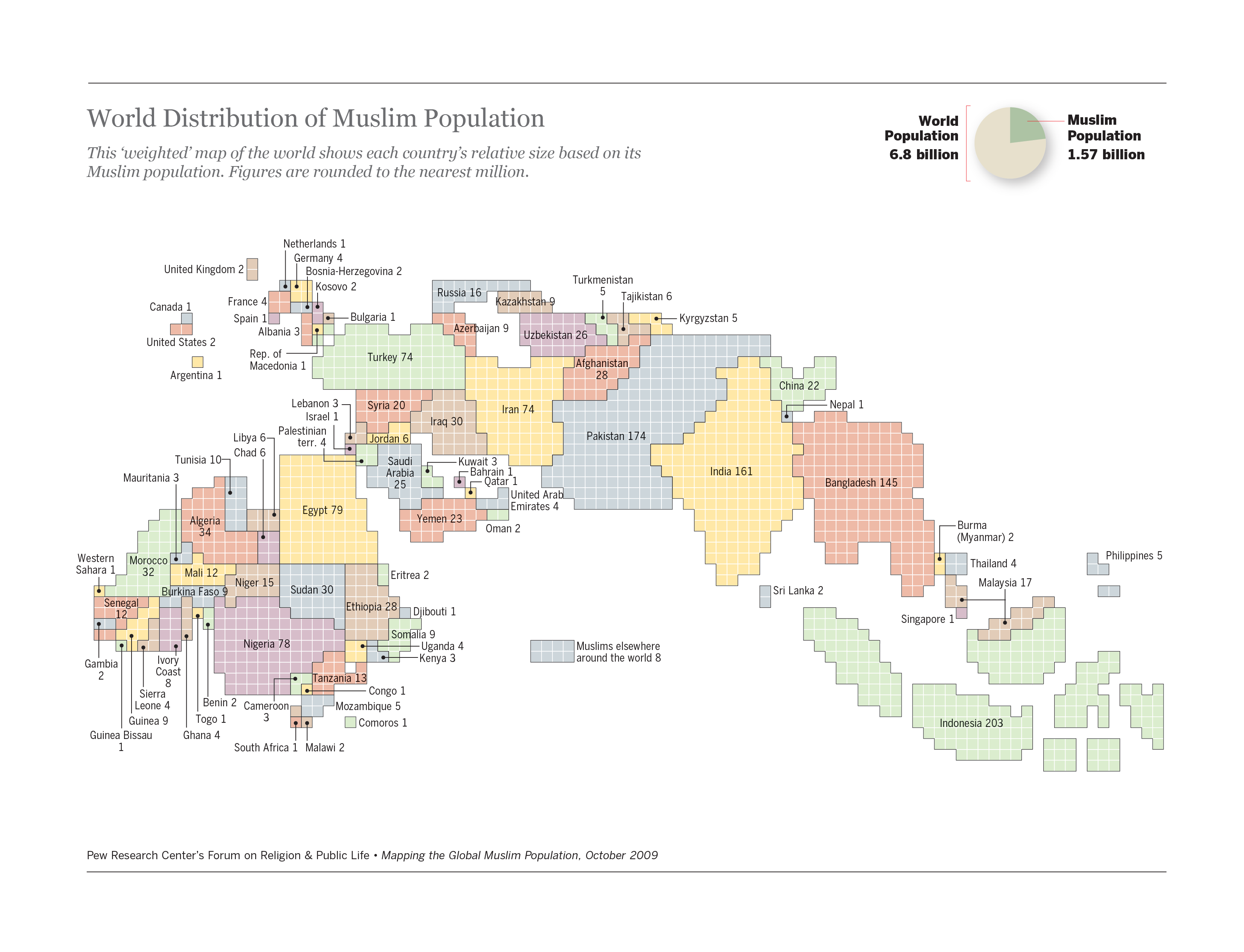
Historically speaking, at the time Columbus set sail, Islam had spread throughout the Middle East, across North Africa, into Spain, and across the Black Sea as various kingdoms and empires from the Saracens to the Ottomans rose and fell. The map below represents the spread of Islam today according to Pew Research.


It stands to reason that Ayuba wasn't the only Muslim person to be enslaved and brought to the United States. History Detectives from PBS estimates that 10 to 15% of enslaved Africans brought to the US were Muslims. If that holds true, that means 2 or 3 of the original slaves brought to Jamestown would have been Muslim. The Africans forcibly brought to the United States were largely purchased at ports along Africa's west coast. Looking at the PEW map, it's entirely possible that 10-15% is accurate.

Of course, these people would have been enslaved and not been allowed to practice their religion freely, and for the most part not allowed to read or write either, so it's hard for us to know exactly who these people were, how many there were, etc. And when we think of these enslaved peoples as property, we forget that they had unique cultures, languages, and religions which were forcibly stripped from them upon being enslaved.

Based on the evidence and accounts available, we must acknowledge that the American Colonies were in fact not really Christian colonies. As has already been argued, in the 17th Century there is no overarching "Christianity", that's a more modern concept, and it's abundantly clear that the three main Abrahamic religions were present in the American Colonies prior to the American Revolution. In the future we'll circle back to this point when we go deeper on the First Amendment, the Freedom of Religion.

Wednesday, July 15, 2020

The Fate of Such - Slavery Starts in Jamestown

After the failure of the Roanoke Colony and finding that tobacco could be potential cash crop to help Jamestown succeed, John Rolfe notes the arrival of enslaved African people...


1619? How did we get here? Let's take a giant step backwards in time. Slavery has a long, storied human tradition. It appears in the Bible: from the captivity in Egypt to the Apostle Paul telling slaves to be obedient to their masters and masters to be good to their slaves. (See Ephesians 6) The ancient kingdoms from Persia, to Egypt, to Greece had well organized systems of slavery. Roman slavery is well documented and studied, and initially it seems for many of the ancient kingdoms, slavery is the result of one kingdom conquering another.

Slavery persists in Europe after the Roman Empire, and as the continent becomes mostly Catholic and transitions to feudal forms of government, slavery is largely phased out and replaced with serfdom. There's a nuanced distinction between a slave and serf to clarify. The slave is the direct property the master or the master's family, the serf is more bound to the master's land or manor. The serf worked the master's land in exchange for security, justice, and some of land of their own to farm. To be clear serfdom was still pretty miserable and was another way for the wealthy, gentry or noble classes to benefit from free or mostly free labor.

Throughout the Middle Ages, slavery in form of one Christian owning another is largely done away with, but slavery is known to have existed in the form of Christians owning Muslims or Muslims owning Christians. As Europeans begin navigating beyond the Mediterranean in the 15th Century, the nature of the European slave trade changes and is legitimized by the Roman Catholic Church.

Pope Nicholas V in 1452 in the Dum Diverseas authorized that Saracens and pagans could be kept enslaved perpetually, and in 1455 in the Romanus Pontifex authorized King Alfonso:

"to invade, search out, capture, vanquish, and subdue all Saracens and pagans whatsoever, and other enemies of Christ wheresoever placed, and the kingdoms, dukedoms, principalities, dominions, possessions, and all movable and immovable goods whatsoever held and possessed by them and to reduce their persons to perpetual slavery, and to apply and appropriate to himself and his successors the kingdoms, dukedoms, counties, principalities, dominions, possessions, and goods"

This is the approach Columbus takes when he sails to the Americas, meets the Taino, and by day 3 has seven people captive on his ship to be brought back to Spain as servants for Queen Isabella. Initially slavery in the Americas uses the local people as the workforce. This system smells a little more like feudal serfdom, these Native Americans live on this land, this land has been claimed for Spain, therefore these people work the land for Spain. There's one major problem with the plan for leveraging the Native Americans for slave labor, epidemic.

As noted in an earlier post, the indigenous people of the Americas had not been exposed to diseases from the Eastern Hemisphere and within 50 years, various American nations are devastated. Diseases like influenza and smallpox spread not only to the nations which have had direct contact with the Europeans but also to other nearby nations as peoples engaged in travel and trade.

Europeans had already explored along the west coast of Africa (remember Dias made it south around Africa to reach in India in 1488), with the new colonies in the Americas short on labor, Europeans turned to another source of slaves, Africa.

At the time European encroachment into Africa was primarily limited to coastal colonies (pretty much true until the development of quinine). It is here that the Europeans are able to trade goods for slaves. Like many other parts of the world, slavery existed in Africa, and like many other parts of the world it was part of the spoils of war, "Those sold by the Blacks are for the most part prisoners of war, taken either in fight, or pursuit, or in the incursions they make into their enemies territories..To conclude, some slaves are also brought to these Blacks, from very remote inland countries, by way of trade, and sold for things of very inconsiderable value - John Barbot.

The Spanish and Portuguese start the Atlantic slave trade very simply by trading European made goods to coastal African kingdoms. And as these people are sold as property, they marked as such, "These being set aside, each of the others, which have passed as good, is marked on the breast, with a red- hot iron, imprinting the mark of the French, English, or Dutch companies, that so each nation may distinguish their own," These enslaved people are now marked for shipping and ready to sail across the Atlantic as property, as Barbot notes, "Many of those slaves we transport from Guinea to America are prepossessed with the opinion, that they are carried like sheep to the slaughter". Their primary job upon reaching the colonies is to grow whatever the local cash crop is, whether growing sugar in the Caribbean or tobacco in Virginia.

That brings us back to Jamestown. The Spanish may have started bringing slaves over, and the English are all too eager to follow suit. The slave trade is a product of religious supremacy as noted in the papal bulls form 1452 and 1455 but also as seen Queen Elizabeth's charter for Walter Raleigh's Roanoke colony. The lives of Saracens, heathens, pagans, etc are simply are not of value, and Christians of the time feel perfectly justified committing violence against people or lands that are not Christian (keeping in mind that it means their particular version of Christianity, as noted in earlier posts on European religious unrest). There's also a practical problem they are trying to solve, colonies across the Atlantic are expensive and difficult to prop up, especially if you don't strike gold upon landing. Massive, industrialized farming appears to be needed in order for agriculture to make colonial profit, and the expense of being a free European who wants to cross the ocean is largely cost prohibitive. The age old, tried and tested, and now religiously approved use of slave labor is the solution. Other solutions will be tried as well and will be discussed in future posts, but the economic foundation of the Virginia colony, the first English colony in the US, is built on slavery.

Jamestown is the first successful English colony in the US. The first enslaved Africans arrived in 1619, right at the point when the colony realizes tobacco is the future, and within a little more than a decade after its founding. We may never know what languages these first slaves spoke or what religions they practiced, although some google searching will suggest they came from Angola. What we can know is that these slaves are amongst the first people to settle in the English colonies, the first lasting English colony to more precise. This American society started culturally pluralistic, and we have often failed to recognize it.

We also shouldn't assume that the Atlantic slave trade was inevitable. It was a convenient solution to be sure, and one which Europeans could easily encourage by trading manufactured goods and helping to prop up kingdoms that were willing to capture and sell slaves. In many ways, it's a precursor to later Imperialism and certain subtler forms of modern day Imperialism and global trade. In the 18th Century, John Wesley writes, "It was some time before the Europeans found a more compendious way of procuring African slaves, by prevailing upon them to make war upon each other, and to sell their prisoners," as he rebukes the rationale for starting and maintaining the slave trade. The choice to start and continue the slave trade was deliberate, and well before Wesley, there were voices of dissent.

One hundred years after the papal bulls which gave legitimacy to slavery, Pope Paul III believing that Jesus intended believers to spread the Gospel to the corners of the Earth, flatly condemns the slave trade:

"Hence Christ, who is the Truth itself, that has never failed and can never fail, said to the preachers of the faith whom He chose for that office 'Go ye and teach all nations.' He said all, without exception, for all are capable of receiving the doctrines of the faith. The enemy of the human race, who opposes all good deeds in order to bring men to destruction, beholding and envying this, invented a means never before heard of, by which he might hinder the preaching of God's word of Salvation to the people: he inspired his satellites who, to please him, have not hesitated to publish abroad that the Indians of the West and the South, and other people of whom We have recent knowledge should be treated as dumb brutes created for our service, pretending that they are incapable of receiving the Catholic Faith."

As we leave Jamestown and 1619, we leave a colony populated with Anglican Englishmen who owe their very survival to the local Powhatan, and who will build their tobacco fortunes on the backs of African men and women. In just this one colony the face of America is already many, but we will explore the other early colonies, we'll see how other peoples formed the foundation of the pluralistic society that we live in today.

Monday, July 13, 2020

Jamestown - Finding Virginia and Violence

After the failure to successfully establish a colony on Roanoke Island, the English don't give up. They make another attempt at establishing a presence in Virginia, it's called Jamestown.


The colony at Roanoke had not gone to plan and a voyage in 1590 found a twice deserted colony; however, this gave the English some time to learn their lessons and to learn from others. As John Smith prepares to set sail for Virginia, drafts a notice ahead of time which suggests a variety of actions from describing a good place to make land to how to defend oneself.


"And to the end that you be not surprized as the French were in Florida by Melindus, and the Spaniard in the same place by the French, you shall do well to make this double provision. First, erect a little stoure at the mouth of the river that might lodge some ten men; with whom you shall leave a light boat, that when any fleet shall be in sight, they may come with speed to give you warning. Secondly, you must in no case suffer any of the native people of the country to inhabit between you and the sea coast; for you cannot carry yourselves so towards them, but they will grow discontented with your habitation, and be ready to guide and assist any nation that shall come to invade you: and if you neglect this, you neglect your safety." - John Smith

As noted in earlier posts, the English Reformation put in England in a difficult spot, especially with regards to Catholic countries. Spain in particular has significant holdings in the Western Hemisphere with claims on Florida, the American Southwest, Mexico, and more. The French have also joined the parade of European nations looking for a passage around or through the Americas to reach India. The City of Quebec is founded in 1608, and serves as a toehold for the French in North America. For English persons headed to the Virginia colony, assistance from England would take time to arrive, and it's clear Smith's first concern is interference from other European nations. In a way, you could almost liken the colonization of the Americas to the space race. European countries attempt to explore and claim land faster than they actually know what they are claiming, mostly to outcompete each other.

His second warning is something of a consistent lesson learned in colonizing the Americas. Initial encounters between local people and Europeans often seem to start well and then become hostile. We established earlier that there was trade between the Native American nations, and we can certainly assume that word travels about the European arrivals. In my last post, I noted that the initial greeting when the English reached Roanoke seemed more aggressive than the greeting Columbus received. Knowing that the first settlers of Roanoke sailed back to England, and that the second group mysteriously disappeared, Smith recommends ensuring that this new group of settlers have a clear path back to the ocean. He also has other advice on their survival:

"In all your passages you must have great care not to offend the naturals, if you can eschew it; and imploy some few of your company to trade with them for corn and all other lasting victuals if you [?they] have any: and this you must do before that they perceive you mean to plant among them; for not being sure how your own seed corn will prosper the first year, to avoid the danger of famine, use and endeavour to store yourselves of the country corn."

The first Roanoke colony had supply problems. Colonization is difficult, you can only carry so much across the ocean, and then you need establish shelter, fortifications, crops, and find some way to produce profit. Smith's suggestion here is to establish good relations with the local people, in particular as a way to attain food.

Other documents from the voyage appear to indicate that initial interactions (accounts from 1602) with Native Americans in Virginia go pretty well. They dine and drink together,

"The seventh, the seignior came again with all his troop as before, and continued with us the most part of the day, we going to dinner about noon, they sat with us and did eat of our bacaleure and mustard, drank of our beer."

 Smith also indicates that other early interactions are agreeable.

"In the midway staying to refresh our selves in little Ile foure or five savages came unto us which described unto us the course of the River, and after in our journey, they often met us, trading with us for such provision as wee had, and ariving at Arsatecke, hee whom we supposed to bee the chiefe King of all the rest, moste kindely entertained us, giving us in a guide to go with us up the River to Powhatan, of which place their great Emperor taketh his name, where he that they honored for King used us kindely" - John Smith

From the early accounts, it sounds as if the Powhatans are willing to guide the English on the river, help them forage for food, and make trade with them. Just after spending a day learning to forage for mussels, Smith claims, "where the first we heard was that 400. Indians the day before assalted the fort, & surprised". The English strengthen their palisade defenses and manage to find peace with their neighbors for a short time after.

And then another setback, this time instead of Native Americans getting sick, some of the English start getting sick. "Shortly after Captaine Gosnold fell sicke, and within three weeks died, Captaine Ratcliffe being then also verie sicke and weake, and my selfe having also tasted of the extremitie therof," and they pray that God would have their neighbors bring them corn, rather than prey upon them while they are ill. After 46 of Smith's compatriots had died and with their supplies dwindling, "the Indians brought us great store both of Corne and bread ready made". If Smith's accounts are to be taken at face value, he spends much of the summer and fall making trades with different Native American villages to bring supplies into the colony that seems to often be on the verge of collapse.

Smith goes on to tell a tale that sounds vaguely Marco Polo-esque. While out with a couple of Native American guides, he and a few men are attacked. Smith survives and is carried away, and then treated as a sort of royal prisoner, where he ingratiates himself with their king and eventually returned to the fort. "The Empereur Powhatan, each weeke once or twice, sent me many presents of Deare, bread Raugroughcuns; halfe alwayes for my father whom he much desired to see, and halfe for me". His accounts seem quite fantastic, but accounts seem to indicate that Smith presides over a period of time where there was some chance for a stable-ish coexistence. After Smith returns to England, things begin to unravel.

By 1610, again short on supplies, a convoy arrives late, and an an assessment of the Virginia Colony is made which lists a variety of faults from the general character of the men of the colony, to the lack of care in mending and maintaining fishing nets, to even a the story of a grizzly murder whereby a man dismembered his wife. This account is almost as fantastic Smith's but in the opposite direction. After accounting for many of the Englishmen's faults and sins, the author notes:

"The state of the Colony, by these accidents began to find a sensible declying: which Powhatan (as a greedy Vulture) observing, and boyling with desire of revenge, he invited Captaine Ratclife, and about thirty others to trade for Corne, and under the colour of fairest friendship, he brought them within the compasse of his ambush, whereby they were cruelly murthered, and massacred.".

The relationship between the English settlers and Powhatans stays sour at this point and devolves into violence. An account from 1614 claims, "Being thus justly provoked, we presently manned our boats, went ashoare, and burned in that verie place some forty houses, and of the things we found therein, made freeboote and pillage." Peace is only able to be brokered after the English are able to hold the chief's daughter, Matoaka or Pocahontas, hostage:

"two of Powhatans sonnes being very desirous to see their sister who was there present ashore with us, came unto us, at the sight of whom, and her well fare, whom they suspected to be worse intreated, though they had often heard the contrary, they much rejoyced, and promised that they would undoubtedly perswade their father to redeem her, and to conclude a firme peace forever with us"

Pocahontas marries John Rolfe, in what feels like a feudal marriage, a marriage to help create a peace between kingdoms. The first interracial marriage in Virginia brings about a short period of peace between Powhatan and the English. Rolfe is able realize the potential of planting tobacco in Virginia, and England begins to see a return on investment. Pocahontas dies in 1617, and the future events are somewhat predictable. The English and Powhatan return to fighting, but the fate of the colony is already decided, a letter from 1619 notes, "All our riches for the present doe consiste in Tobacco". The letter foreshadows other events of 1619, John Rolfe's notes from the same year highlight the coming of colony's first slaves, a "free" labor source to help make cropping in the colonies profitable.

Jamestown might be a lesson in what could have been. Perhaps there was a window of opportunity for Europeans peoples and Americans peoples to chart a path together. Or perhaps Jamestown is simply a foreshadowing of future events with English settlers arriving on the coast, working their way inland, taking whatever land they can, and then using slave labor to work stolen land.

Sunday, July 12, 2020

The First Colony of Virginia Starts in North Carolina

Queen Elizabeth I reigns during a time of unrest in England after her father, Henry VIII, broke away from the Roman Catholic Church in order to secure a divorce; her brother Edward doesn't last long on the thrown; her sister, Mary becomes queen and tries to reverse the course of the English reformation and attempts by force to bring the country back to the Catholic Church. After Mary's death, Elizabeth is now queen of England and Ireland and her church...


Elizabeth's reign is an interesting time for both English history and world history, and whole sets of college coursework can be found on Elizabethan England, the Tudor-Stuart House, and early modern Britain & Ireland. There's exactly 0 chance of me unpacking all of that here. What's most important  to be aware of is that:
  • On the continent of Europe the Protestant Reformation is playing out. England's in a tricky spot because Ireland, France, and Spain are Catholic. The English crown is currently Anglican, which while not Catholic, it isn't really seen as truly protestant either as opposed to Lutherans or Calvinists. (Reformation as being played out by German and Dutch reformers and Scottish Presbyterianism)
  • The global picture has Spain as the dominant naval force. At about the same time as Elizabeth was born, Pizarro massacres the Incans and executes their emperor. Spain is extracting goods for trade (tobacco) and gold out of the New World. Stolen New World gold is filling Spanish coffers. The Spanish Empire is very much on the rise and Spain's Armada (navy) is the means. European kingdoms become quickly aware of the need to explore and colonize in order to keep pace.
  • Domestically, Elizabeth has her hands full. She isn't married, she's the "Virgin Queen". Rulers from outside England and the English nobility are all interested suitors. She also has religious affairs to attend to and anyone not participating in the Anglican church like Catholics is a potential threat to her rule.

Enter Sir Walter Raleigh, whose name will one day be given to the capital of North Carolina. As noted above, Queen Elizabeth has plenty to keep her eye on during her reign, including Irish Catholics (subjects to the English crown, despite not being English or Anglican, or having much say in the matter) connect with Spanish and Italian Catholics in common cause. The rebellion takes places on Irish soil where English gentry had been given rights to Irish lands and turned these into plantations (If this sounds a bit like American history, that's because it is.) This particular uprising in 1580 takes place in Munster, where Spanish and Italian forces had joined Irish Catholics in revolt. Walter Raleigh was an officer in the English response and appears to have participated in the Massacre at the Siege of Smerwick. Raleigh ends up being one of Queen Elizabth's closest allies and suitors and is granted the rights to colonize part of the Americas.


The language used in granting these rights is worth noting specifically: "discover, search, finde out, and view such remote, heathen and barbarous lands, countreis, and territories, not actually possessed of any Christian prince, nor inhabited by Christian people, as to him, his heires and assignes, and to every or any of them shall seeme good, and the same to have, holde, occupy".


In short, Raleigh has the go ahead to go adventuring. Any land he finds that is populated by non-Christian (probably means non-Anglican based on the religious events of the day) is his to keep because those currently in possession are just barbarians anyway. Queen Elizabeth is well aware that the Spanish encountered nations across the ocean. She certainly expects that Raleigh will as well, and she's given him the go ahead to dispossess these nations of their land.

The plan for the English colonization of the Americas is something being tested out in Ireland, and which Walter Raleigh already some experience of from his time Ireland during the Munster rebellion.

Walter Raleigh funds and assembles the expedition to establish a colony in the Americas, ultimately be called Virginia, named after her majesty the Virgin Queen. The first attempt at colonization is led by John White who lands at Roanoke Island (in modern day North Carolina).

The initial encounter between the English and local Algonquins is described like this:

"Inhabitants therof as soone as they saw us began to make a great and horrible crye, as people which never befoer had seene men apparelled like us, and camme a way makinge out crys like wild beasts or men out of their wyts. But beeng gentlye called backe, wee offred them of our wares, as glasses, knives, babies, and other trifles, which wee thougt they deligted in. Soe they stood still, and percevinge our Good will and courtesie came fawninge uppon us, and bade us welcome. Then they brougt us to their village in the iland called, Roanoac, and unto their Weroans or Prince, which entertained us with Reasonable curtesie, althoug they wear amased at the first sight of us."

This interaction sounds roughly similar to Columbus' first interaction with the Taino. Europeans arrive on ships. The people already living there come out to greet them (arguably in a more aggressive fashion this time), and they are start with an amicable meeting, sharing goods and greeting the local village and leaders. The attire of the local people is one of the first things noted including descriptions of hair, robes, and jewelry made of pearls and copper.

The village where the English arrive is described thusly:

"Their townes that are not inclosed with poles are commonlye fayrer then suche as are inclosed, as appereth in this figure which livelye expresseth the towne of Secotam. For the howses are Scattered heer and ther, and they have gardein expressed by the letter E. wherin groweth Tobacco which the inhabitants call Uppowoc. They have also groaves wherin thei take deer, and fields wherin they sowe their corne"

The local people are planting and harvesting corn which as noted in an earlier post was a staple food crop in the Americas. What's also noteworthy here is the description of growing tobacco in a garden. Tobacco had become known to the Europeans as the Spanish began to bring it back. This is a new world plant which we are familiar with today, and like today it was used for smoking. The English at this point don't know it but the writing is already on the wall for Virginia.

Unlike the Spanish who encountered civilizations that had amassed some gold which the Spanish stole to fill their coffers, and then used to pay for their Armada; there is no gold, just the copper and pearl jewelry. The future success of the colony won't be in repossessing Native American gold, the English are eventually going to need to learn to grow Native American crops for a profit.

A colony is setup on the island in 1585, and the colony fails to thrive. The situation is described like this:

"They answered him that they lived all; but hitherto in some scarsity: and as yet could heare of no supply out of England: therefore they requested him that hee would leave with them some two or three ships, that if in some reasonable time they heard not out of England, they might then returne themselves.".

Their supplies and food are low, and they ask Francis Drake to leave ships (when he stops by apparently in the midst of other voyages) so they can return to England if they want.

Colonization is hard. Some small number of people need to find or grow food successfully, build their own housing, and craft whatever tools or parts they need without the usual resources. They also know that any help from England is a long time away. Colonization is even harder if you thought that you were going to land and immediately find gold which could be funneled back to Walter Raleigh and the Queen of England, but you fail to find any.

The first colony is abandoned by the English who return with Drake bringing corn, tobacco, and potatoes back to England.

A more famous second attempt is made which plays out more like an episode of Unsolved Mysteries. The Lost Colony continues to be the one taught in US History classes as it's the one that captures our imaginations.

However the story of the first colony teaches a number of valuable lessons: First, we can see clearly that the English intention is clearly to repossess whatever land they can from whatever people are already living there. Second, we can also see that this isn't a first attempt at this kind of colonization, it's something these same figures were trying in Ireland. Third, we can see the foreshadowing that colonization of North America is going to take longer to fetch a real return on investment; it will have to grow up around trade and farming rather than looting temples and cities of their gold.


But at the end of the day, the first of the 13 colonies is effectively established.