Showing posts with label religion. Show all posts

Saturday, July 18, 2020

Plurality of Religions - Colonies of New Netherlands and Maryland

The Reformation in Europe brought with it much unrest in England, as much discussed, the unrest often played out as Anglican vs. Catholic vs. Puritan. On the continent, this played out in events like the 30 Years War (1618-1648). This unrest is a major player in the formation of the American colonies as various groups looked to escape incarceration, violence, political persecution, and war.


In a previous post, we touched on the arrival of Puritans, as the Pilgrims settled in Massachusetts. Before arriving in Massachusetts, the Pilgrims migrated to the Netherlands, seen as a place of religious tolerance. At around the same time as the Pilgrims get settled in Massachusetts, (we'll talk about state sponsored monopolies in the future), the Dutch West Indian Company organized  the colony of New Netherlands, including founding a port city on the Hudson River, New Amsterdam (today's New York).

New Netherlands initially finds its fortunes in the fur trade, As noted in 1626,"The ship which has returned home this month [November] brings samples of all sorts of produce growing there, the cargo being 7246 beaver skins, 675 otter skins, 48 mink, 36 wild eat, and various other sorts". The colony itself is naturally founded by Calvinist Dutch Reformers, and it is to the best of my understanding that my earliest ancestor in the US was a deacon in the First Dutch Reformed Church (Teunis Covert).

It is clear that in the 1620's on the Atlantic Coast in what will be the 13 colonies of the American Revolution, there are English Puritans in Massachusetts, Dutch Reformers in New Amsterdam (New York City), Anglicans and Africans in Jamestown, and of course the Native Americans who already had their own established nations and religions here. But a little deeper digging into religious unrest in Europe will reveal others fleeing persecution and landing in New Amsterdam.

As noted in the post about Christopher Columbus, he set out from Spain during the Spanish Inquisition. In 1492, Jews are expelled from Spain. Many eventually end up in the Netherlands, as noted by Bradford (one of the Pilgrims) as place of religious freedom. Religious unrest in Europe doesn't just present itself in the form of Catholic monarchs like Ferdinand and Isabella, the Reformation itself poses a threat to European Jews. Martin Luther, the father of the Protestant Reformation, writes a treatise entitled the "Jews and Their Lies":

"Therefore be on your guard against the Jews, know that wherever they have their synagogues, nothing is found but a den of devils in which sheer self glory, conceit, lies, blasphemy, and defining of God and men are practiced....First set fire to their synagogues or schools and to bury and cover with dirt whatever will not burn, so that no man will ever again see a stone or cinder of them. This be done in honor of our Lord..."-Martin Luther

A reformed Europe isn't any safer for the Jewish people, if anything it may have been less safe. Just as other persecuted peoples flee to the Western Hemisphere, Jews begin to arrive in New Amsterdam in 1654 and found the Congregation Shearith Israel..

Other examples of religious plurality can be found further south. Maryland, named after the Virgin Mary, is found by Cecil Calvert, remembered in US History classes as Lord Baltimore. Maryland is founded as a haven for English Catholics, much like the Puritans, finding a home further away from the English Crown is a safer option than living in England. The Charter of Maryland is granted in 1632 by King Charles I. Catholics were looking for refuge from the Protestant Reformation, and would still find persecution through out the US History, as the fear of "papists" was on full display as late as the 1928 presidential election and anti-Catholicism dogged even JFK during his presidential run.

At this point in the 17th Century, the three main factions openly engaged against one another in the British Isles are now setting up their own havens across the Atlantic. Dutch Reformers have a colony wedged in between with a Jewish congregation in the main port. By the time the Congregation Shearith Israel is setup, it's been 35 years since the first Africans arrived in Jamestown, and enslaved Africans were first sold in the Massachusetts colony 16 years earlier. If Colonial America is starting to sound more diverse than you remember, that isn't an accident or mistake. Someone makes the decisions about what ends up in textbooks and is taught in schools (do some googling on the Texas State Board of Education).

In doing some digging on Maryland, I came across an interesting account from later in colonial history, a story from around 1730, which got me thinking a little bit more about what the world of the 17th and early 18th Century looked like. The account from 1730 is of Ayuba Suleiman Diallo, a Senegambian merchant and son of a Muslim cleric, who is sent by his father to sell two of their slaves at a port near the Gambia River. Ayuba has the misfortune of being attacked while en route by Mandigo bandits; he stripped of his valuables, clothing, etc, and sold into slavery at the port himself. Ayuba ends up in Maryland where he comes to be known as Job.

While assigned to work on the plantation, he "withdraw(s) into the woods to pray; but a white boy frequently watched him, and whilst he was at his devotion would mock him, and throw dirt in his face. This very much disturbed Job, and added considerably to his other misfortunes; all which were increased by his ignorance of the English language." Ayuba was a Muslim, enslaved, practicing his religion in the American colonies in 1730.

Historically speaking, at the time Columbus set sail, Islam had spread throughout the Middle East, across North Africa, into Spain, and across the Black Sea as various kingdoms and empires from the Saracens to the Ottomans rose and fell. The map below represents the spread of Islam today according to Pew Research.
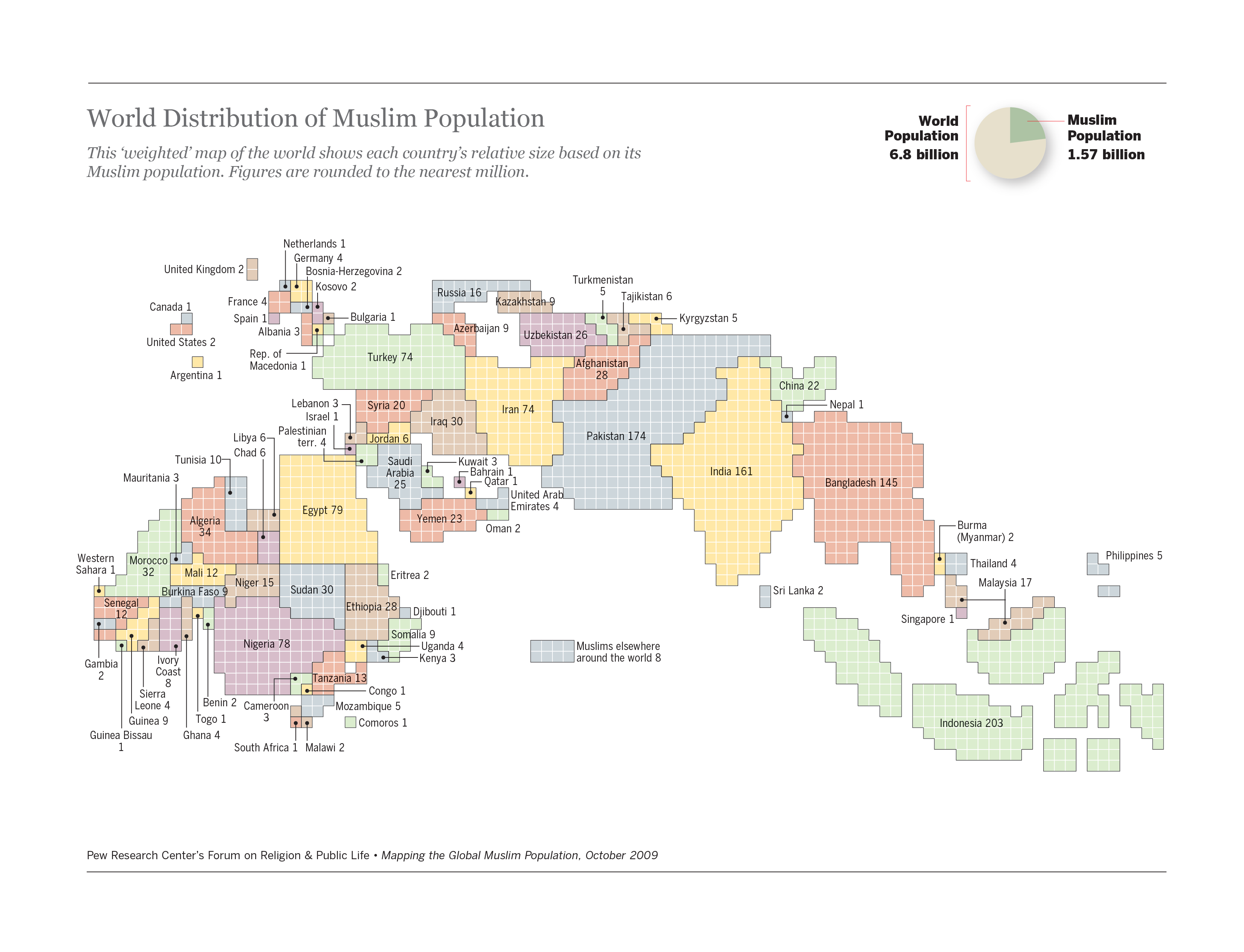


It stands to reason that Ayuba wasn't the only Muslim person to be enslaved and brought to the United States. History Detectives from PBS estimates that 10 to 15% of enslaved Africans brought to the US were Muslims. If that holds true, that means 2 or 3 of the original slaves brought to Jamestown would have been Muslim. The Africans forcibly brought to the United States were largely purchased at ports along Africa's west coast. Looking at the PEW map, it's entirely possible that 10-15% is accurate.

Of course, these people would have been enslaved and not been allowed to practice their religion freely, and for the most part not allowed to read or write either, so it's hard for us to know exactly who these people were, how many there were, etc. And when we think of these enslaved peoples as property, we forget that they had unique cultures, languages, and religions which were forcibly stripped from them upon being enslaved.

Based on the evidence and accounts available, we must acknowledge that the American Colonies were in fact not really Christian colonies. As has already been argued, in the 17th Century there is no overarching "Christianity", that's a more modern concept, and it's abundantly clear that the three main Abrahamic religions were present in the American Colonies prior to the American Revolution. In the future we'll circle back to this point when we go deeper on the First Amendment, the Freedom of Religion.

Saturday, July 11, 2020

Skipping Cortez and Pizarro and Jumping Back to England

In 1492 CE, Italian navigator Christopher Columbus led a Spanish expedition to the Americas. Within three days of encountering the native Taino, he enslaved some and claimed their island home in the name of the Spanish crown. His voyages to the Americas popularized the European quest to find an easier route to India, the known route was sailing south around Africa....

The Spanish sent subsequent expeditions to find gold, spices, slaves, and any other valuables that could be claimed for the crown. Two of the best known voyages and conquests are Cortez's war against the Aztecs and Pizarro's massacre of Incas and execution of their emperor. It can be argued that teaching about Cortez's destruction of the Aztec Empire adds value to understanding US History: the spread of old world diseases as an epidemic, the enslavement of the native peoples is the foundation of New Spain, and Spanish Colonial territory which spread as far North as the American Southwest. And some point, we'll revisit some of this. I submit however that teaching about the destruction of the Aztec and (especially) Incan (in Peru) civilizations as part of US History is way to avoid talking about atrocities committed against native people in the United States. Textbook makers can point to these as examples of what Europeans did when they reached the Americas without it being the forefathers of the 13 American Colonies on the Atlantic coast. It's an effective way to talk about a real and uncomfortable issue without really talking about it.

So as we are not going to dwell on Spanish colonies in Mexico and South America, then we can skip ahead to the establishment of colonies on North America's Atlantic Coast.

In order to understand the colonization of the Atlantic coast, revisiting England is useful as these are mostly English colonies. As noted in an earlier post, the Roman Catholic Church has been the glue that held European society uneasily together. In 1517, just 25 years after Columbus sailed to the Americas, the protestant reformation begins. The reformation shakes the foundation of European society. Ten years after Martin Luther writes his 95 theses, King Henry VIII requests the Pope to annul his marriage to Catherine of Aragon.

In 1529, Parliament (we'll come back to Parliament) is called to consider religious reformation, and Thomas Cromwell, a reformer, enters stage right prepared as a lawyer to argue in favor splitting with the Roman Catholic Church. In 1532, the House of Commons (part of Parliament) passes Cromwell's petition, Supplication against the Ordinaries In short, this is a list of grievances targeted at the church's ability to enforce religious laws like charging / punishing people for heresy and raised concerns about clergy who held both the powers to enforce church law while also potentially holding positions within the English state. A longer story made short, the eventual outcome is that King Henry VIII becomes the head of the church in England in place of the Pope and the Anglican Church is born, starting the English Reformation.

This next part might be easiest to tell via a Timeline, but the key information to hold on to is that the state and church are the same. (ie the king or queen is now the head of the state (government) of England while also the head of the church of England, this means anyone who is not part of the state's religion can be perceived as threat to the state.)
  • Edward VI - coronated 1547 - Anglican
  • Mary I - coronated 1553 - Catholic
  • Elizabeth I - coronated 1559 - Anglican
  • James I - coronated 1603 - Anglican
  • Charles I - coronated 1633 - Anglican
  • English Civil War - 1642
  • Charles I - executed - 1649
  • Commonwealth of England - established as a Republic - 1649 (could be described a military dictatorship of Oliver Cromwell)
Each of these rulers passed laws about how church services should be held, defined religious rites, enforced particular prayer books, and either persecuted, imprisoned, executed or waged war against people who would not be compelled to follow. English Catholics and the Irish were regular targets but so were Puritans, Scottish Presbyterians, etc. Coalitions formed periodically to persecute one group or other, but this was period of significant civil and religious unrest in the British Isles.

This time period also overlaps with the foundation of colonies on the Atlantic coast. Maryland as an example is founded as refuge for English Catholics. While a Puritan settlement is founded in Massachusetts. It's important to keep in mind (and it is evident from the unrest), that there isn't a unified view of Christianity, instead each group is pretty confident that they are on the righteous path and the others are wrong in fact,  so wrong that people take up arms against one another, including the 30 Years War fought in modern day Germany.


There are two other things to establish as part of the backdrop for the English colonization of the Americas. One is Parliament, the other is the Magna Carta. Parliament was as a close to a legislature as existed for it's time. It was composed of two houses: The House of Lords (essentially English Lords or clergy), and the House of Commons (knights or city representatives). Parliament was a council for the monarchy and sort of a check and balance. The Magna Carta, written in 1215 was a list of rights (in particular rights of barons) but these included protection against illegal imprisonment, taxation reforms, and protections for the church. This document gets additional attentions after the turmoil of the English 17th Century and by Enlightenment thinkers.


The English establish Roanoke Colony in 1585, and subsequent colonies during this time of unrest. This unrest and English institutions like Parliament, the Magna Carta, and the Commonwealth of England will influence the formation of the United States a century later. This all serves as the backstory for future posts.

Thursday, July 9, 2020

European Crisis and the Quest to Reclaim Roman Glory

At this point we've established that Americas first peoples migrated to the Western Hemisphere during the Last Ice Age; they spread out over the continents establishing different cultures, cities, cultivated a variety food crops, and told their stories through art...

These nations made war, brokered peace, while some rose, and some fell. Some are well know, and some we may never know. For nearly 15,000 years these tribes or nations or countries developed into complex agricultural societies that spanned from Eastern forests to Southwestern deserts to the Andes in South America to the frozen coastline of Alaska.


Across the ocean, in 27 BCE Caesar Augustus becomes arguably the first true emperor of Rome. After grappling with Julius Caesar and ultimately assassinating him, the Senate of the Roman Republic loses significant power under Augustus putting Senators at odds with whoever the emperor is for most of Roman history. The Romans conquer most of Europe, North Africa, and the Middle East, building roads, bathes, arenas, civic building, monuments, and walls as they go.


For a few centuries, the Romans hold the line against migrating Germanic tribes. Rome falls in the 5th Century, and Goths, Franks, Saxons, and others spread out into Western Europe. And most of European history afterwards chases after the glory of Rome.


Imagine that it's the year 600 CE, you are a Frankish villager carrying your goods to market. You pass a Roman aqueduct on your way with it's arches flying high into the sky, and you realize that you, your people, and your kingdom have no ability to build that. It's a sort of inferiority complex living in Rome's shadow, but the kingdoms of Europe try hard to rebuild Rome.
  • In the 6th Century, Justinian manages to retake parts of the old Roman Empire in the name of the Constantinople.
  • In late 8th Century and early 9th Century, Charlemagne conquers much of Western Europe and is crowned Emperor of the Romans by Pope Leo III.
  • A host of kings and emperors wage war across Europe from Charles V to Napoleon to Hitler. Various rulers have tried to rule all of Europe.
  • In Eastern Europe the tsar's derived their title from the word caesar.
  • In government buildings and museums from Washington DC to London to Paris to Berlin inspiration is taken from Roman architecture 

After the fall of Rome, Europe spends a lot of time in crisis. The Moors conquer modern day Spain, leaving the Franks feeling pressure to the west. Waves of migration and raids from the Norse and the Magyars affect how the nations of Europe develop. Places like Northern France end up being fought over time and again because the feudal system of government and conquest leaves William Duke of Normandy, also King of England. France and England would be at war from Henry V to Joan of Arc in the Hundred Years War.


The one unifying force in Western Europe through most of the Middle Ages was the Roman Catholic Church. The church has a fascinating impact on Europe. Monasteries are where Latin literature and ideas survive. The church provides the inspiration for the construction of churches and cathedrals and the rebuilding of an artisan class. The church is also the unifying force which brought Europe together to massacre the peoples of the Middle East during the Crusades.


The Crusades are Western Europe's first attempt at colonization. The Crusader States are established on the coast of the Mediterranean. The cost in lives of Jews, Muslims, and even Eastern Christians as a result of Crusades may never be known, but we do know that Western Europe benefited in at least two ways: 1) the establishment of trade for goods like silk and spice across the Mediterraneans and 2) rediscovering Greek writing which had been preserved in the Caliphates of the Middle East.


The Latin and Greek works are studied in the universities which spring up around cathedrals. Cities of artisans and traders form around these churches too. It creates a new social class that is not peasant, not clergy, not noble. A little more educated, a little more wealthy, a class that can bring about the Renaissance. The Renaissance is arguably the closest Europeans felt to the Romans since the fall of Rome. Works of art like Michelangelo's David have a distinctly Greco-Roman feel, and that's entirely intentional.


That's not to say that as Europe exited the Middle Ages that it wasn't still a continent in crisis. Increased trade leads to waves of plague as stowaway rodents are off loaded with goods. And eventually around 1000 years after the original fall of Rome, Constantinople the last Eastern Roman city falls to the Ottoman Turks. Much like the Franks once felt pressure from the Moors to the West, Vienna feels the pressure of the Ottomans to the East.


And just for fun, the institution which had been a unifying force for Europe, the Roman Catholic Church, is about to be rocked by the Protestant Reformation. Europeans are about to adventure beyond the Mediterranean during a time of religious turbulence.